Revolutionary War Veteran Laments Secession of South Carolina
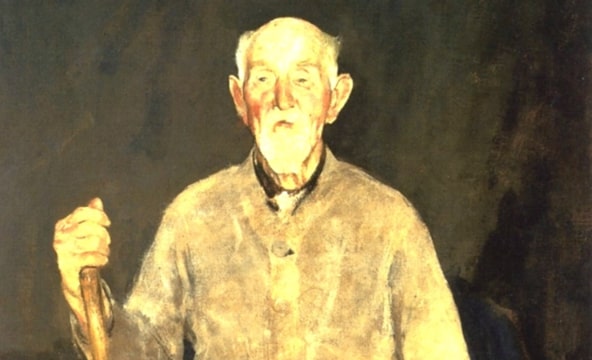
When South Carolina became the first Southern state to secede from the Union, on Dec. 20, 1860, an ancient American had a unique perspective on this harbinger of the Civil War. Ralph Farnham, at 104, was the last Revolutionary War veteran still alive; the last living witness of the heroism and sacrifice that created the Union in the first place. He died six days after South Carolina seceded.
An obscure poet, Sarah T. Bolton, wrote a poem imagining Farnham’s last dream before he died, lamenting South Carolina’s secession. In sentimental tones typical of the period, Bolton’s poem expresses the emotions many of her readers felt: incredulity and sorrow that the Union was breaking apart. Her poem was published in the March 1, 1861, issue of the Farmer’s Cabinet (Amherst, New Hampshire) —one month after the formation of the Confederate States of America, and one month before the attack on Fort Sumter began the Civil War:
Ralph Farnham’s Last Dream
In the midst of his children’s children,
By the home fire’s cheering blaze,
An old man sat in an easy chair,
Dreaming of by-gone days;
Dreaming of wearysome marches,
By flood, morass and wold,
Where many a brave heart fainted
With hunger and thirst, and cold:
Dreaming of midnight watches
In the dreary, drizzling rain,
And the hum of his comrades’ voices,
That he never should hear again;
Of the smoldering fires of the bivouac,
The sentinel’s measured tread,
The smoke and roar of the battle,
And the faces of the dead—
Of the fair young son of his neighbor,
Who fought and fell by his side,
And the sacred message that he gave
To his girl-love when he died.
He saw the face of the maiden grow
As cold as death and as pale,
As he sat by her father’s hearth-stone
And told her the cruel tale.
“Ay, ay!” in his sleep he murmured,
“She was fair and he was brave,
But she faded away like a blossom,
And we made her a soldier’s grave.
But we routed the British legions,
And sent them over the sea,
For the God of Battles helped us,
And our native land was free.
“My son, I have been dreaming
A dream that gave me pain;
I thought I was young and a soldier,
Fighting for freedom again;
I saw the tents and the banners,
And the shining ranks of the foe,
And the crimson tracks of our poor recruits
Left on the frozen snow.
“But is it true, this rumor,
Or only an idle tale—
Do they talk of dissolving the Union?”
Ah, well may your cheek grow pale,
And well may the old man tremble,
And his heart beat faint and low,
When he thinks of the price it cost us
Some four score years ago!
“I have watched its growing greatness
Through a life of many years,
But I never forgot that its blessings
Were purchased with blood and tears.
I never forgot the privations
Of four score years ago,
When the naked feet of our poor recruits
Left crimson tracks in the snow.
“I never forgot their faces,
And I seem to see them still,
Who looked straight into the face of death,
At the battle of Bunker’s Hill.
“And so the home of Marion
Is the first to break the band
That bound the beautiful sisterhood
Of our beloved land;
The children of the heroes
Around whose memory clings,
The glory of King’s Mountain,
Cowpens, and Eutaw Springs!
“I saw our blessed banner,
With its white and crimson bars,
When fair South Carolina
Was one of the thirteen stars;
And if ever that constellation
Is marred or rent in twain,
It would blast the sight of these poor eyes
To see its folds again.
“If God has forsaken our country,
The only boon I crave
Is that he will delay its ruin
Till I have gone down to my grave;
For I could not breathe with traitors,
Nor turn my face to the sun,
Nor dwell in the land of the living,
When the States are no longer one.”
(Note: Bolton’s reference to “the home of Marion” is Francis Marion, a South Carolinian officer in the Revolutionary War known as the “Swamp Fox” for the guerrilla tactics he used to frustrate the British in their occupation of South Carolina. The references to “King’s Mountain, Cowpens, and Eutaw Springs” are three important American victories in the Revolutionary War, all fought in South Carolina.)
Click here for more articles about the American Civil War.


I understand that when writing a blog, it’s necessary to show a picture and say a few words about yourself, so that people don’t think a nameless, faceless committee or advisory board is running the show. Here I am, a real person. My name is Tony Pettinato, and I live in Deerfield, Mass. I did my undergraduate studies in English at Oberlin College, my graduate work in Journalism at UC Berkeley, and have been a reporter for six newspapers. For the past fourteen years I have worked at NewsBank, six of those as a managing editor for the U.S. Congressional Serial Set project – NewsBank’s acclaimed effort that digitized and indexed twelve million pages of primary source documents – that gratified my lifelong interest in American history. And that led me to editing this history blog!
Websites: