The Controversial Birth of Martin Luther King, Jr. Day

Today the United States celebrates the national holiday Martin Luther King, Jr. Day, continuing to honor the slain civil rights leader nearly 45 years after his assassination in Memphis, Tennessee, on April 4, 1968. This famous advocate of nonviolence helped raise the civil rights movement to national prominence, forever changing American society. He also was a champion for economic justice for the nation’s poor, and was becoming a leader in the anti-Vietnam War protest movement when he was murdered. King won the Noble Peace Prize in 1964.

To many, it would seem that honoring such a pivotal figure with a national holiday would be an obvious choice for America’s government and public, but that was not the case. There was a great deal of opposition to President Reagan’s signing the bill on Nov. 2, 1983, creating the holiday. Reagan himself had earlier opposed the bill, supposedly because giving federal employees the day off with pay would be too expensive.

Reagan had threatened to veto the bill but backed off when it was passed by such strong veto-proof votes in Congress (78 to 22 in the Senate and 338 to 90 in the House of Representatives). At a press conference two weeks before signing the bill, Reagan begrudgingly said he would sign it “since they (Congress) seem bent on making it a national holiday.” He then went on during the press conference to speculate that FBI documents might reveal King’s communist sympathies. He also wrote Meldrim Thomson, the governor of New Hampshire, that the public’s high regard for King was “based on an image, not reality.”

When the bill first came before the House of Representatives, in 1979, it failed passage by five votes. Senator Jesse Helms (R-North Carolina) led opposition to the bill in the Senate, questioning King’s qualification for such an honor and grousing about his “Marxist” tendencies. When it came up for the Senate vote, John McCain (R-Arizona) was one of the 22 senators who voted against it. Even after the bill’s passage and Reagan’s signature, various states refused to recognize the holiday, with Arizona and New Hampshire being the last two holdouts. It was not until 2000 that Martin Luther King, Jr. Day was officially observed in all 50 states.

Here is coverage of President Reagan signing the bill, as presented in an article published by the Augusta Chronicle (Augusta, Georgia) on Nov. 3, 1983:

President Signs King Holiday Bill

Washington (AP)—With Martin Luther King’s widow at his side, President Reagan signed legislation Wednesday he once opposed that honors the slain civil rights leader with a national holiday each year. Reagan said King had “stirred our nation to the very depths of its soul” in battling racial discrimination.

Congressional leaders and veterans of the civil rights movement, including Jesse Jackson, the Rev. Ralph Abernathy and Atlanta Mayor Andrew Young, filled the Rose Garden for the signing ceremony.

The proceedings climaxed as the crowd softly sang “We Shall Overcome”—the anthem of King’s non-violent crusade against segregation.

His widow, Coretta Scott King, told the crowd, “America is a more democratic nation, a more just nation, a more peaceful nation because Martin Luther King became her preeminent non-violent commander.”

While saying the nation had made huge strides in civil rights, Reagan declared, “traces of bigotry still mar America.”

He said King’s holiday should serve as a reminder to follow the principles that King espoused: “Thou shalt love thy God with all thy heart and thou shall love thy neighbor as thyself.”

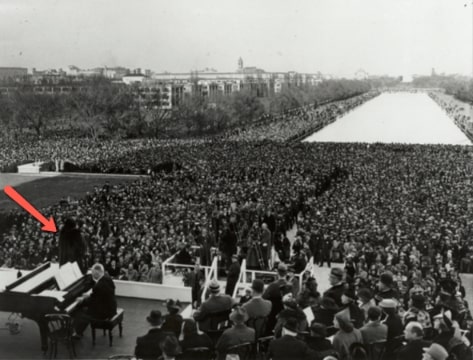
Recalling King’s historic address to 250,000 people at the Lincoln Memorial in 1963, at the height of civil rights battles, Reagan said:

“If American history grows from two centuries to 20, his words that day will never be forgotten: ‘I have a dream that one day on the red hills of Georgia, the sons of former slaves and the sons of former slave owners will be able to sit down together at the table of brotherhood.’”

The legislation makes the third Monday in January a legal public holiday, beginning in January 1986.

For the day of the signing ceremony, at least, civil rights leaders put aside their policy differences with the administration and their anger over Reagan’s earlier opposition to honoring him with a national holiday.

“Well, we’ve all had high and low moments and this is one of his high moments,” said Jackson, an outspoken Reagan critic and newly announced candidate for the Democratic presidential nomination.

Jackson said the only thing that mattered was Reagan’s signature on the bill.

“The effect is that the civil rights movement and its place in American history is institutionalized, and that’s very significant,” Jackson said.

Reagan originally had expressed concern over the cost of honoring King with a national holiday, and said he would have preferred a day of recognition.

At a news conference Oct. 19, Reagan said he decided to sign the legislation “since they (Congress) seem bent on making it a national holiday.” At that same session, Reagan publicly speculated on whether secret FBI files would show that King was a communist sympathizer. For that remark, the president later apologized to Mrs. King.

Reagan also wrote former New Hampshire Gov. Meldrim Thomson that the public’s perception of King was “based on an image, not reality.”

Mrs. King told reporters she had accepted Reagan’s apology for his news conference remark. As for his letter to Thomson, she said, “I am not questioning motives at this point. I think we have to accept what people say and then we watch what they do.”

White House deputy press secretary Larry Speakes noted Reagan’s apology to Mrs. King and said, “I don’t think a day like today calls for discussion from us on that kind of controversy. I honestly don’t see how you can add any more controversy to this.”

Sen. Edward M. Kennedy, D-Mass., said after the ceremony, “I think as an optimist and someone with hope. I would hope that now, that this is the beginning of this administration’s real commitment to the basic and fundamental rights of people in our society.”

While criticizing Reagan’s firing of three Civil Rights Commission members who criticized the administration, Kennedy added, “I’d rather look to today and think that perhaps the administration will move on a different path in the future than it has in the past.”

In his remarks, Reagan said, “In America, in the ’50s and ’60s, one of the important crises we faced was racial discrimination. The man whose words and deeds in that crisis stirred our nation to the very depths of its soul was Dr. Martin Luther King Jr.”

For more information on Dr. Martin Luther King, Jr., visit the King Center website.

Click here for more articles about Dr. King and African American History.